Case study: Bayer cuts its harvest logistics costs by 25%.
Find out how an operational reorganisation, made possible by Sautec conveying equipment, has transformed the harvest collection logistics of seed producer Bayer.
In summary.
The client:
Bayer, a major player in seed production.
This case study covers three sites (two collection sites and one production unit) spread across the french departments of Ariège and Aude.
Challenge:
During a harvest period lasting 5 to 8 weeks, Bayer transports large volumes of maize seed to the production plant in a continuous, uninterrupted flow.
The initial logistics organisation for harvesting relies on the drying skips and hookloaders. This is a complex system that results in high logistics costs.
Solution:
Transition from a logistics model based on the drying skips to one that favours semi-trailers. This logistical change has been made possible by the installation of new handling equipment: a truck unloader and two receiving hoppers.
This equipment simplifies and optimises the transfer of corn cobs and grains to semi-trailers.
Results achieved:
- 25% % saving on transport costs per tonne.
- Reduction in the number of drying skips from 300 to 60.
- €240,000 in annual savings on skip hire.
- Simple, flexible and replicable logistics.
- An improvement in Bayer’s overall competitiveness in a highly competitive regional market.
The client: Bayer seeds SAS.
As a leading producer of maize and rape seeds, Bayer grows seeds throughout the Occitanie region (France). Its maize harvesting operations are mainly based at three sites spread across the Ariège and Aude departments:
- The Trèbes production unit: the final destination for all maize flow (grain and corn of cobs).
- The Saverdun logistics site: dedicated mainly to the transit of maize grain for drying and the transit of corn on the cob.
- The Bram site: dedicated to the transit of corn on the cob.
Context and logistical challenges.
“During a very short harvest period of 5 to 8 weeks, we have a significant influx of seeds that must be transported, in a continuous flow, to the Trèbes facility. Operations must be perfectly coordinated to preserve the quality of seeds.“
Théo Lafond, Field operation lead commercial seeds | Bayer
The crops come from a large part of the Occitanie region, within a radius of over 130 km around the factory. Around 70% of the maize is harvest on the cob, with the remaining 30% harvested as grain. This breakdown determines the logistics arrangements, the necessary equipment and our client’s constraints.

The limitations of the initial organization.
Initially, our client handle and transports maize cobs and grain straight from the harvest using drying skips. These skips are taken directly to the production facility in the case of maize cobs, or are first transported to the Saverdun drying site in the case of maize grain.
At the height of the harvest, more than 300 skips are in circulation between the fields, transit areas and the industrial plant.
For Bayer, this logistics model presents several issues:
- High transport costs: a hookloader with two skips carries around 20 tonnes of maize per journey, compared to 30 tonnes for a semi-trailer. For a transport cost that is almost identical, this represents a 33% loss of capacity per journey.
- Increased handling: the frequent handling of skips in the fields and on site increases costs and the risk of accidents.
- An oversized fleet of skips : the 300 skips in circulation, some of which are leased at around €1,000 per year, drive up fixed costs.
- A complex and opaque organisational structure, likely to cause supply disruptions during busy periods.
The solution: switching to semi-trailer transport.
Bayer’s objective was therefore to transform its harvest logistics model to optimise costs. The solution adopted to achieve this was follows:
- Deliver all maize cob harvests to the production unit in moving-floor semi-trailers.
- After drying, transfer the grain stored in the drying skip to semi-trailers to optimise the logistics flow between the Saverdun dryer and the Trèbes production unit.
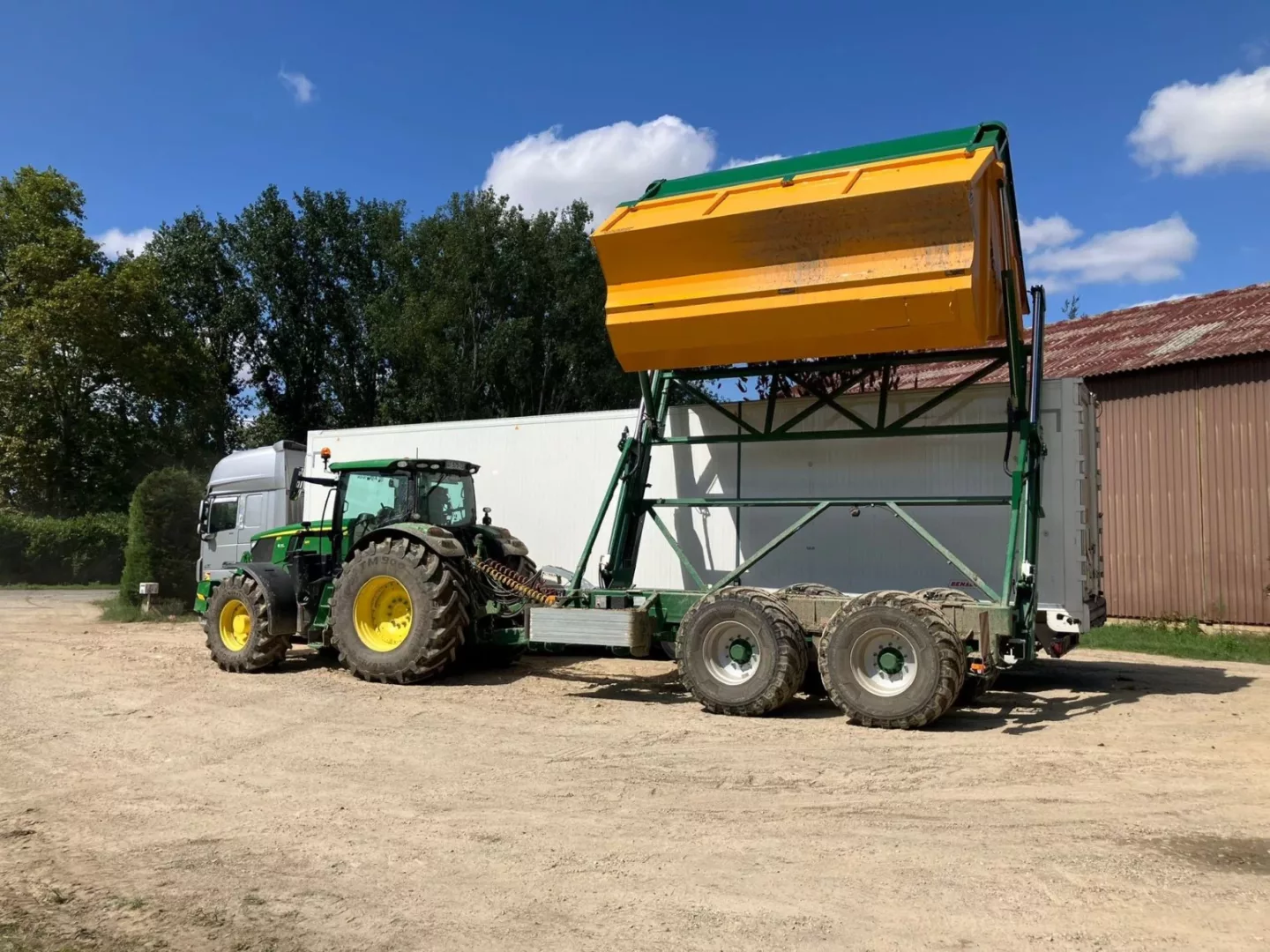
Corn on the cob: direct loading in the field.
For maize harvested on the cob, the preferred logistics approach is to load the crops into semi-trailers directly in the field. Side-dump transfer vehicles are used for this purpose.
This is a viable option when semi-trailers can get within a kilometre of the harvest field and a suitable area is available to carry out the transfer safely.
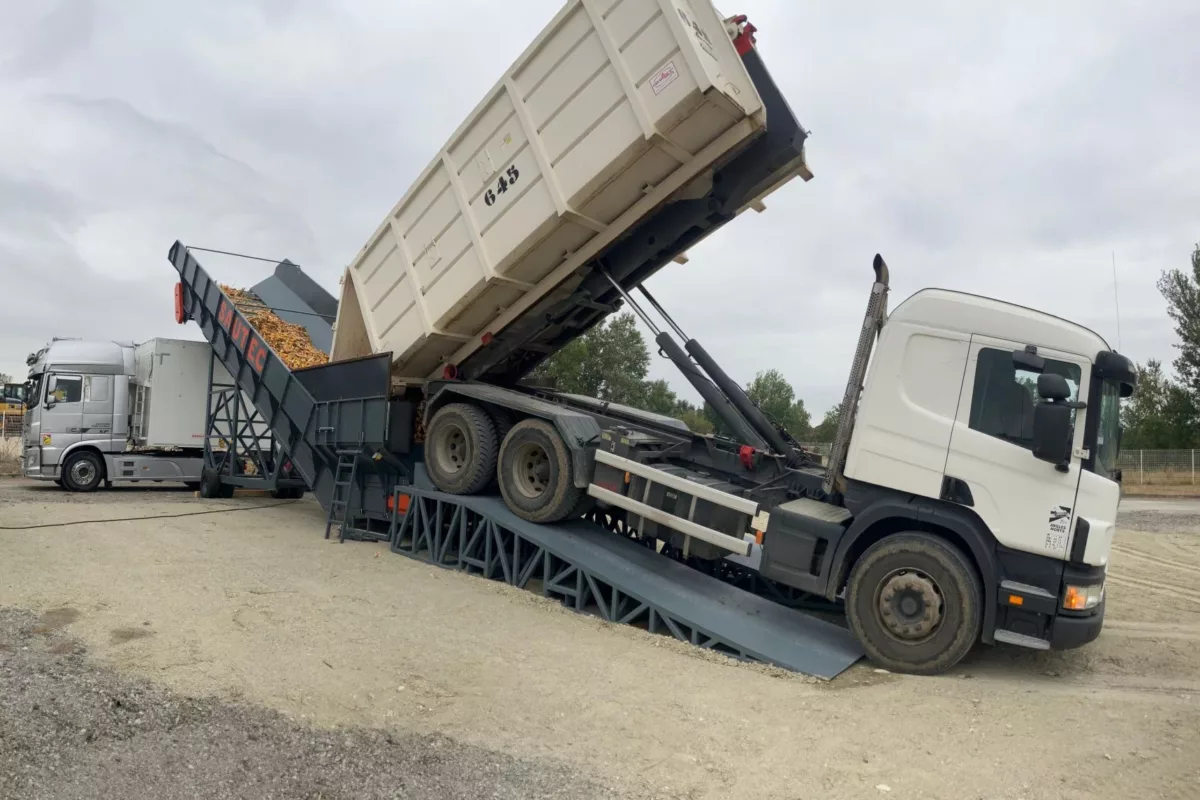
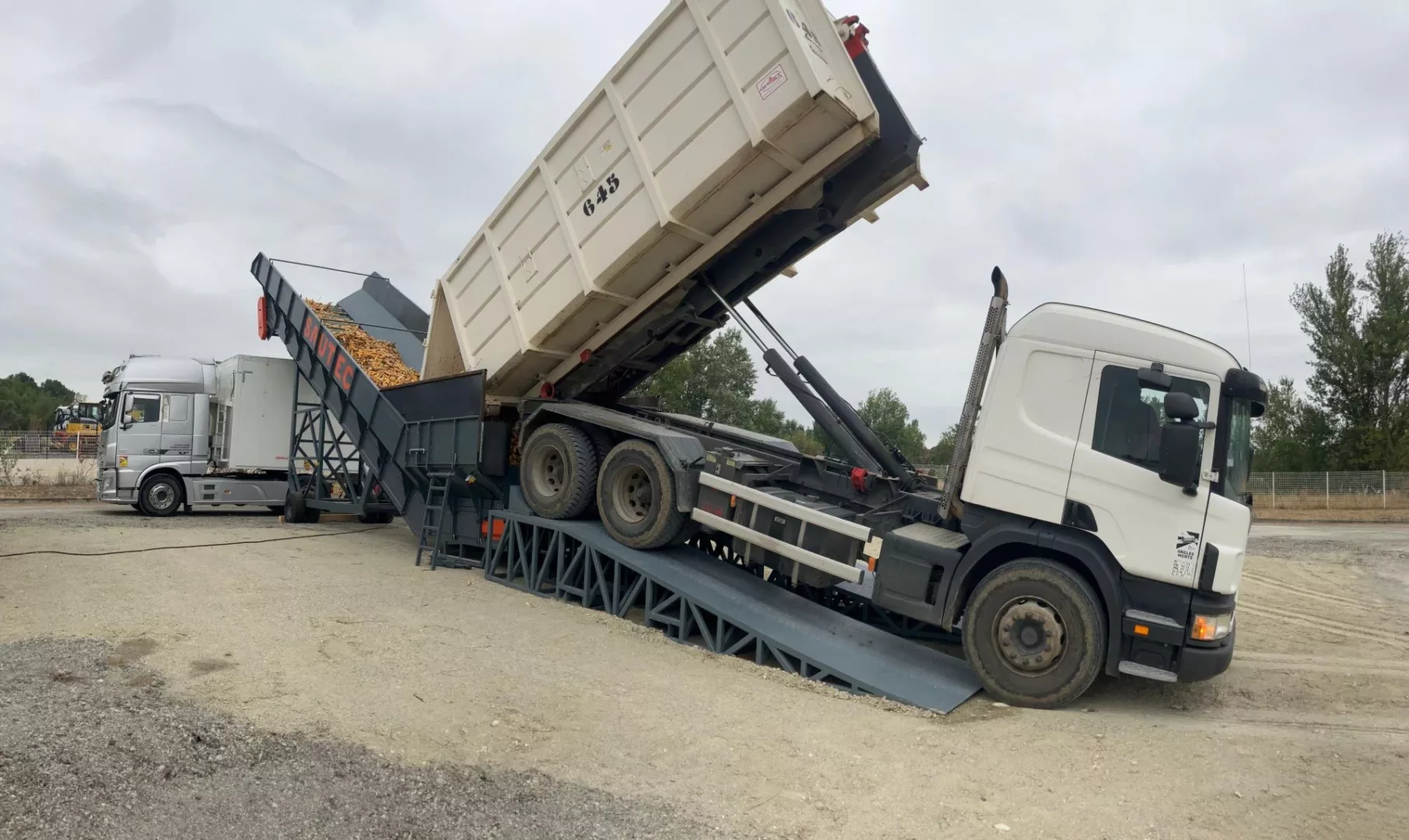
If this is not the case, collection is carried out as before, using drying skip. The transfer of maize cobs between the hookloader and the moving-floor semi-trailers is then carried out using a custom-made receiving hopper, designed and manufactured by us.
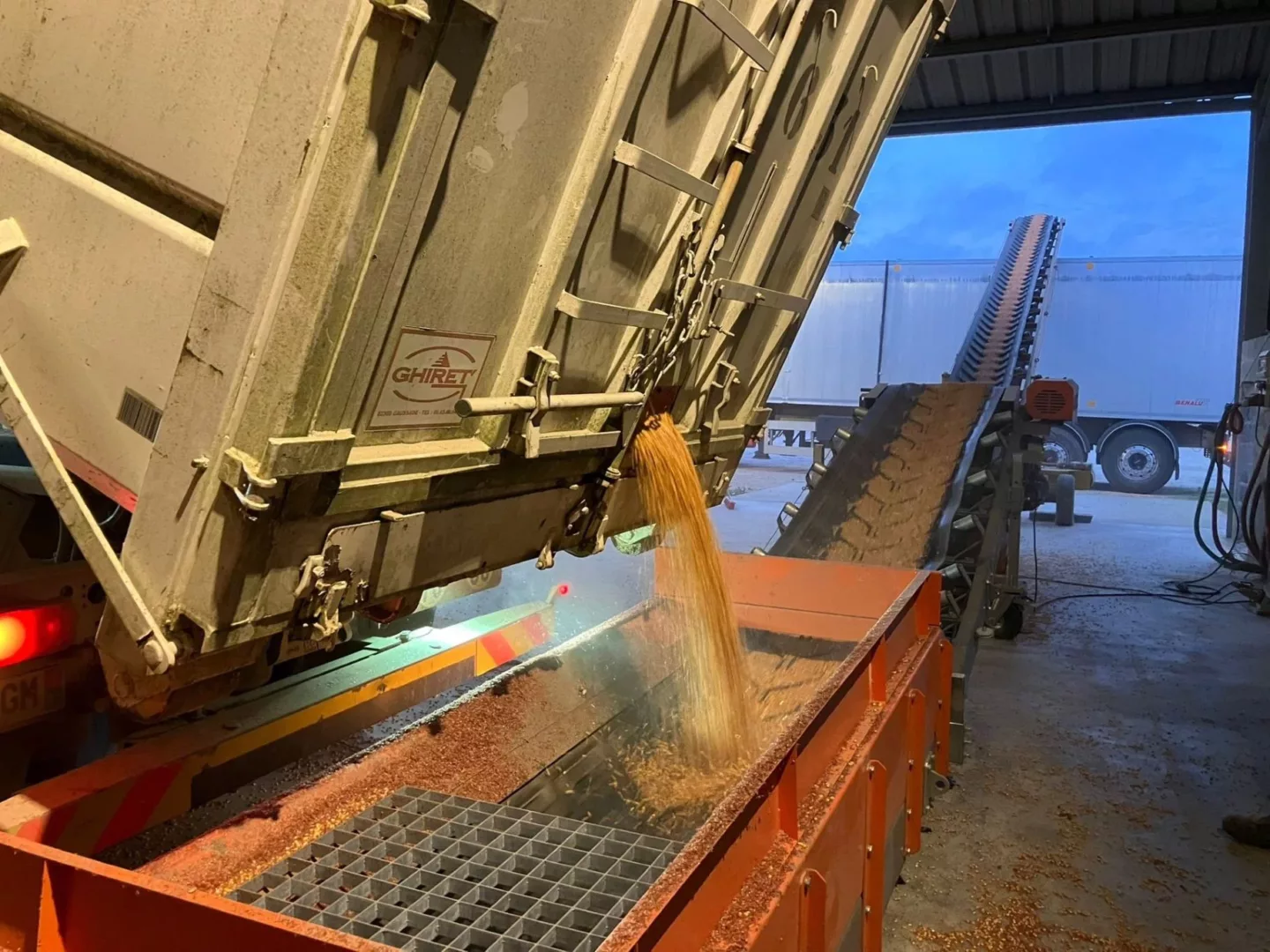
Grain maize: optimising the flow after drying.
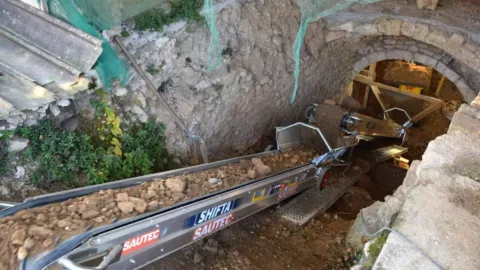
For grain maize harvests, the harvesting method remains unchanged. It is still carried out using drying skips. However, once the grain has been dried, the contents of the skip are transferred to a semi-trailer using a truck unloader and a mobile belt conveyor. This procedure optimises the flow between the Saverdun dryer and the Trèbes production unit.
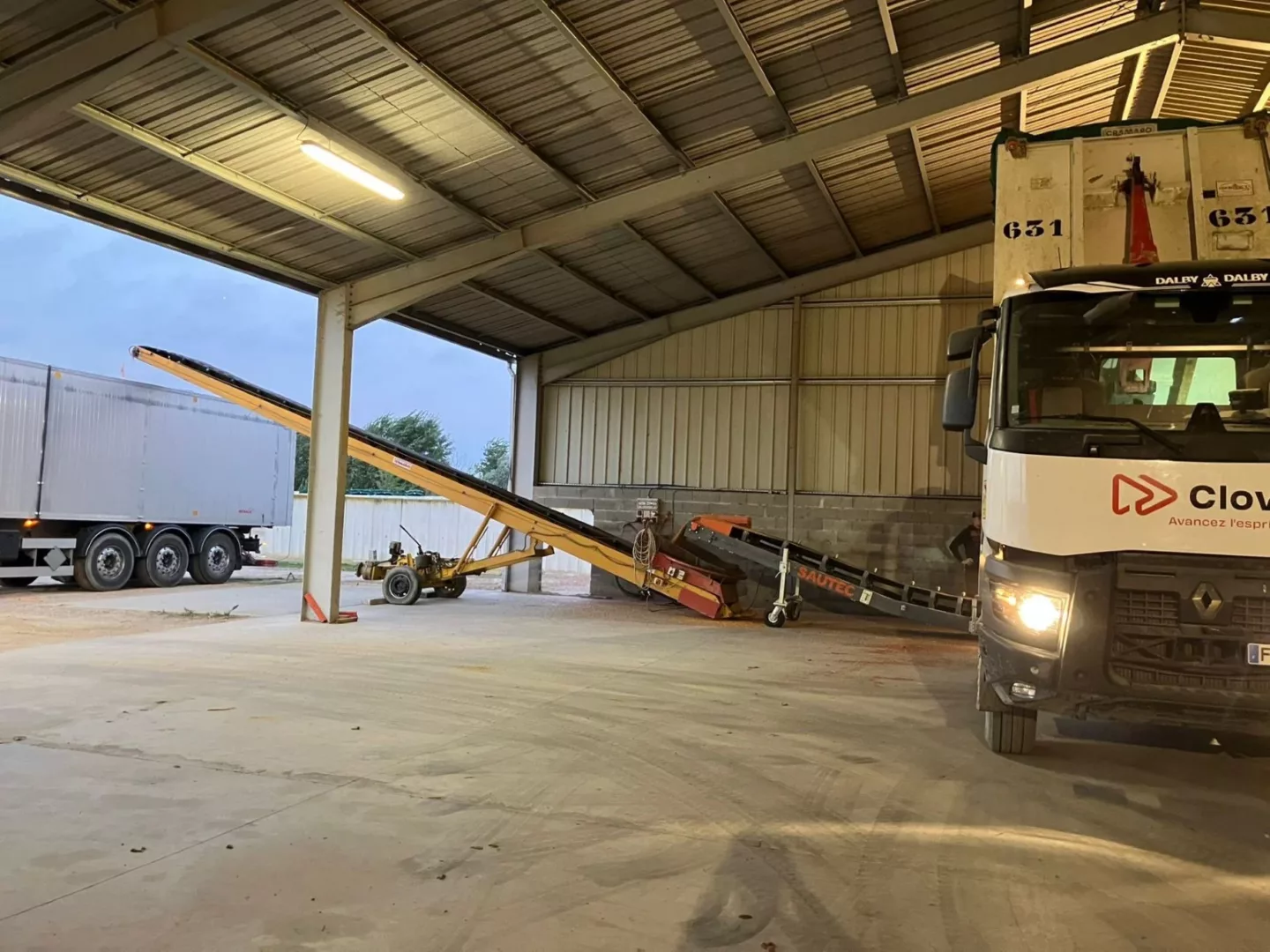
Sautec equipment at the heart of the system.
To support this change in operational model, Bayer entrusted us with the supply of several handling equipment.
A truck unloader and a receiving hopper for the Saverdun site.
All the grain maize crops are brought to this site to be dried. The dryer has a capacity of 12 skips, operating on a 24-hour cycle, which amounts to approximately 100 tonnes per day.
After drying, the grain maize stored in the drying skip is transferred to semi-trailers using a truck unloader combined with a mobile belt conveyor.
The receiving hopper is used for maize cobs in very specific circumstances, particularly when adverse weather conditions prevent transhipment in the fields. In such cases, the use of the hopper ensures that deliveries to Trèbes can continue using surplus stock from previous days.
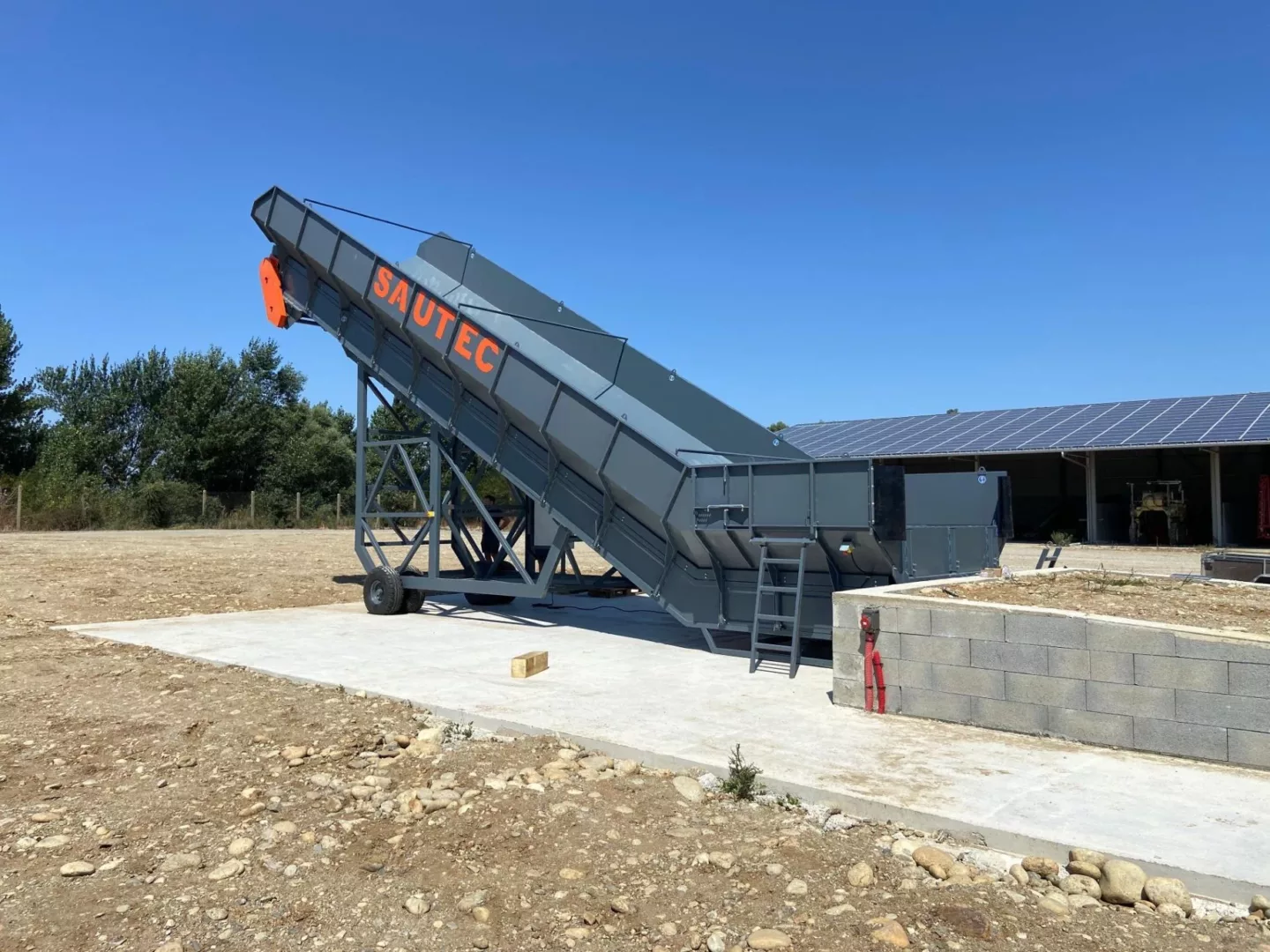
“The receiving hopper was only used for around a hundred skips during the 2025 season, as the weather was favourable for loading corn on the cobs directly in the filed.”
Théo Lafond, Field operation lead commercial seeds | Bayer
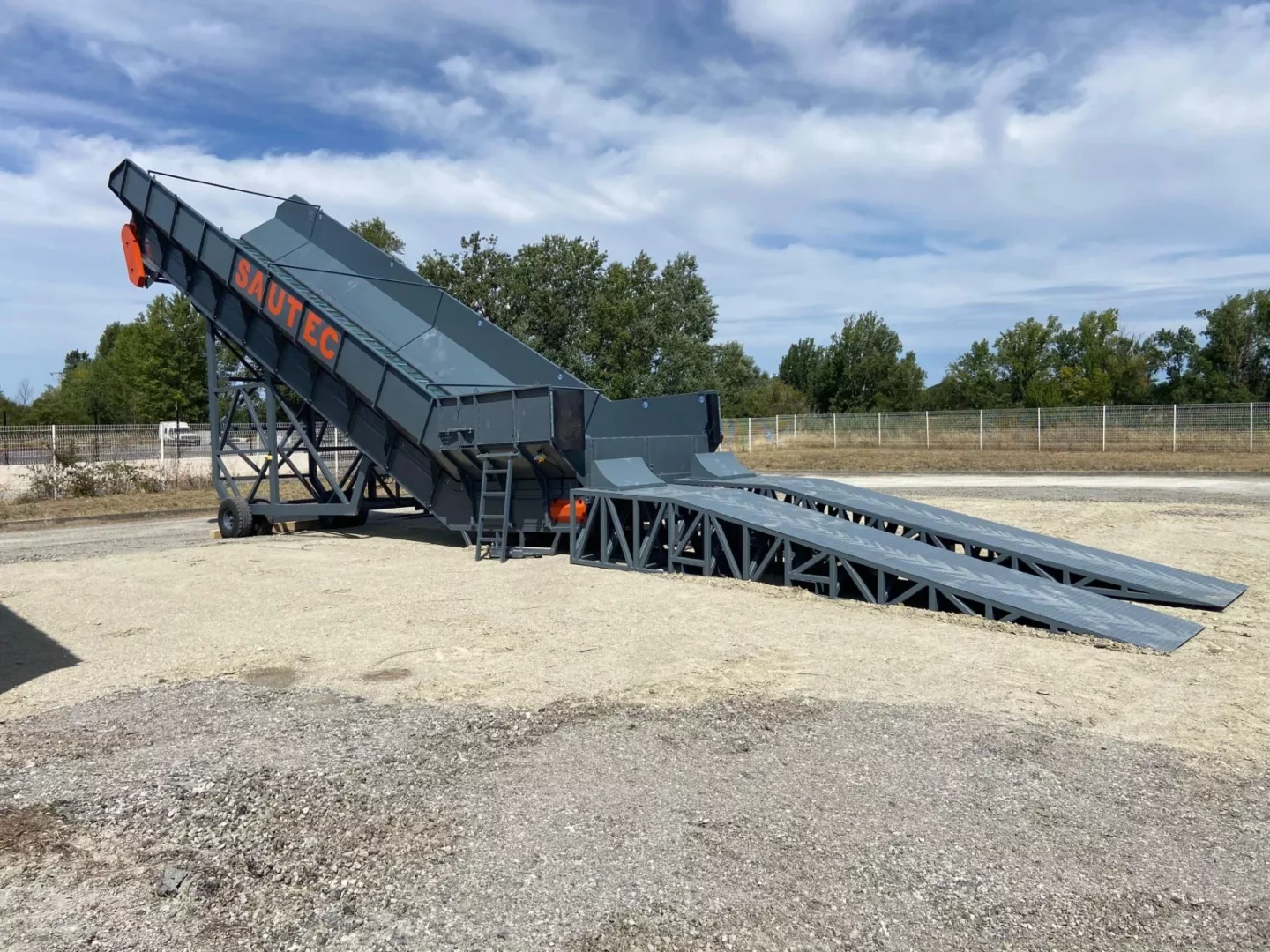
A receiving hopper for the Bram site.
At the Bram site, which handles only maize cobs harvested, the main constraint is that there is only one harvesting machine in this area, and its output is insufficient to supply the Trèbes production unit on a just-in-time basis. Harvesting is therefore carried out using skips to create a ‘buffer stock’.
The receiving hopper then transfers the maize cobs stored in the skips to the moving-floor semi-trailers, at a rate matching the productivity of the Trèbes plant. Unlike at Saverdun, the Bram hopper is used daily throughout the entire harvest period.
Focus on the receiving hoppers supplied.
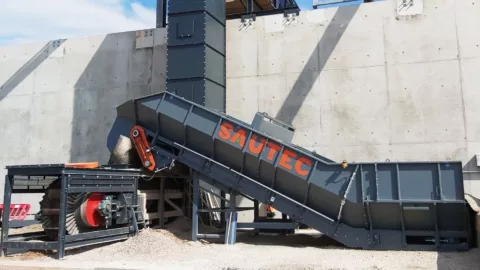
The two receiving hoppers supplied were designed and manufactured to meet the customer’s specific requirements and operating conditions. Our expertise enables us to produce fully customized hoppers.
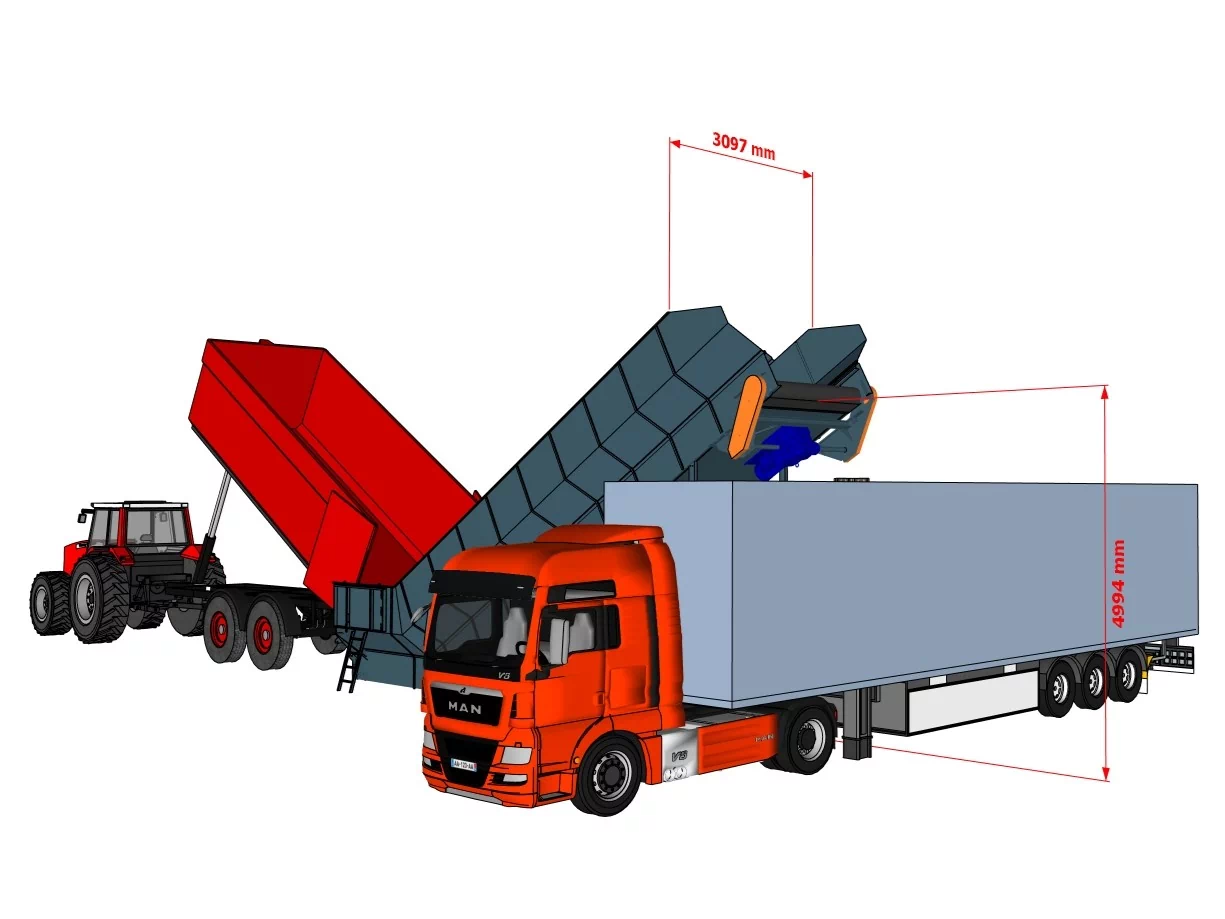
Each hopper features a 3.5-metre-wide receiving area to facilitate the alignment and unloading of agricultural trailers with their rear doors open.
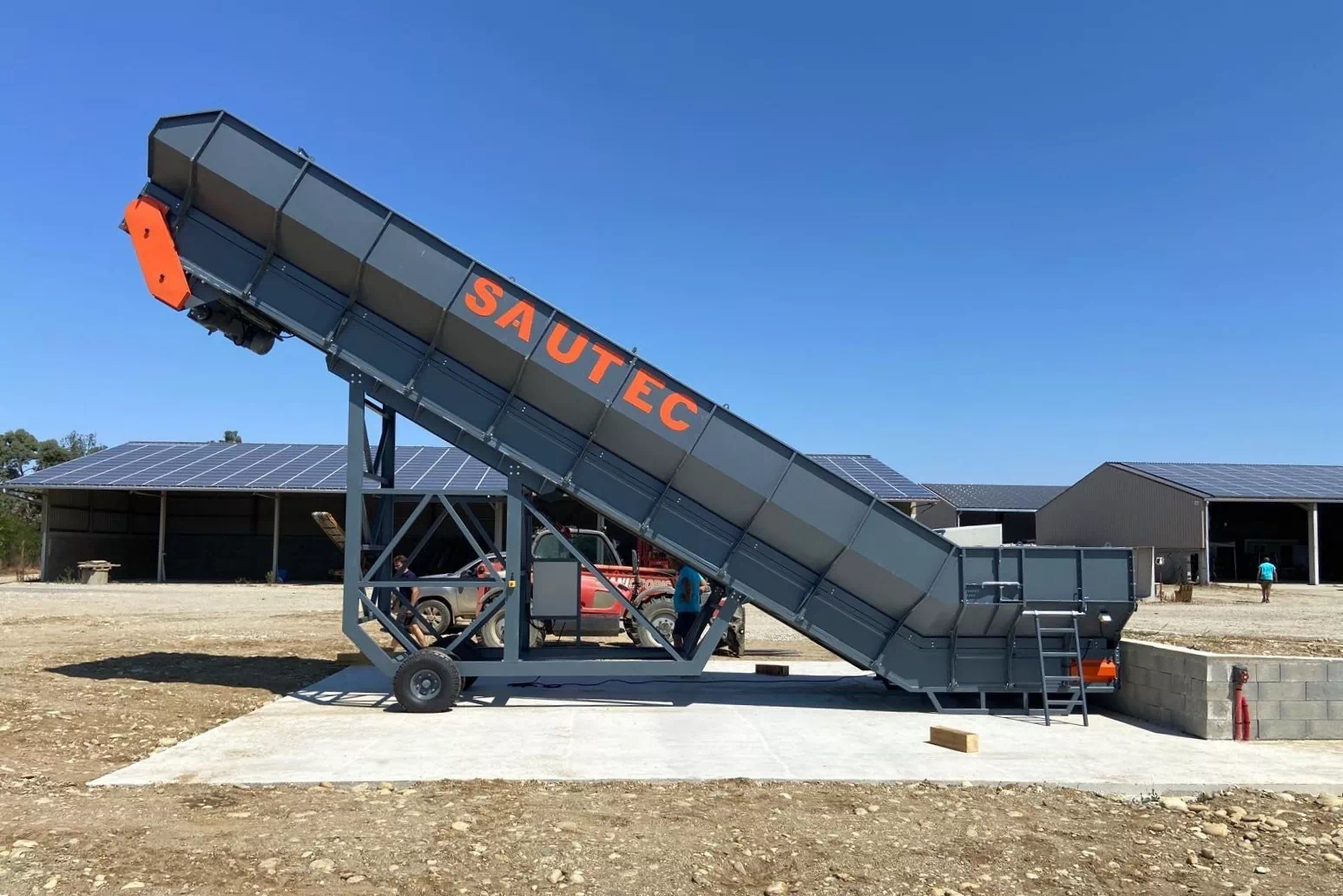
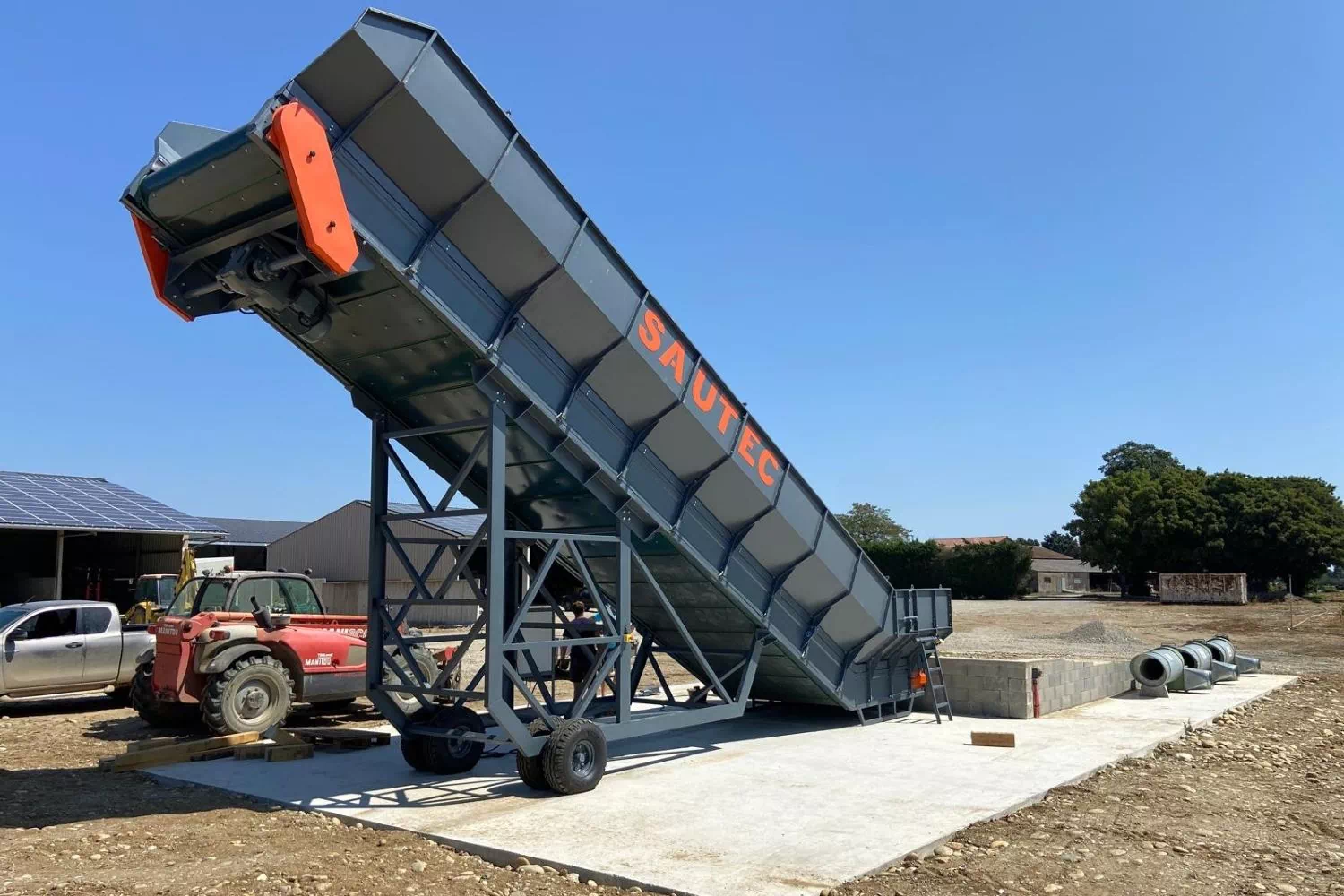
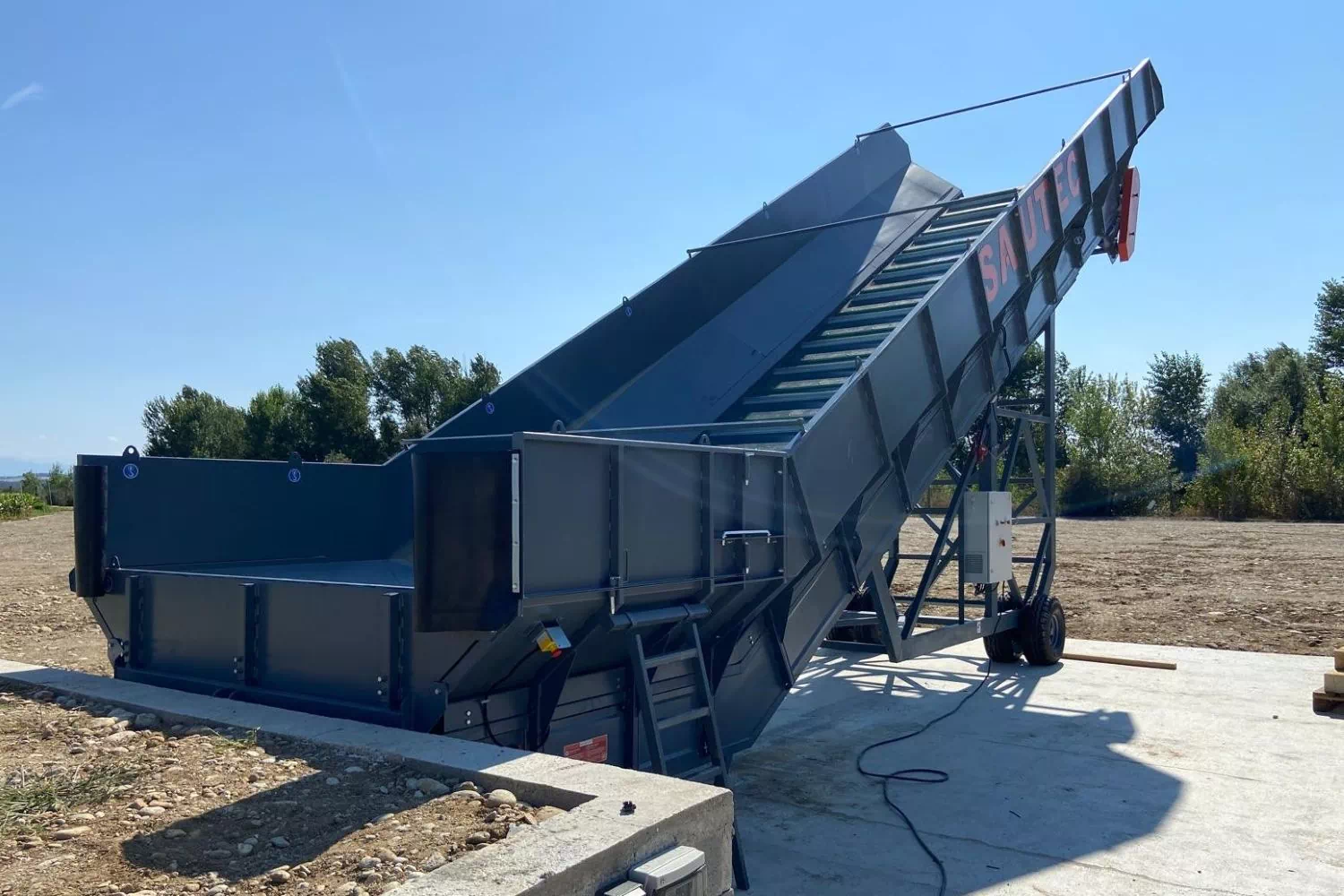
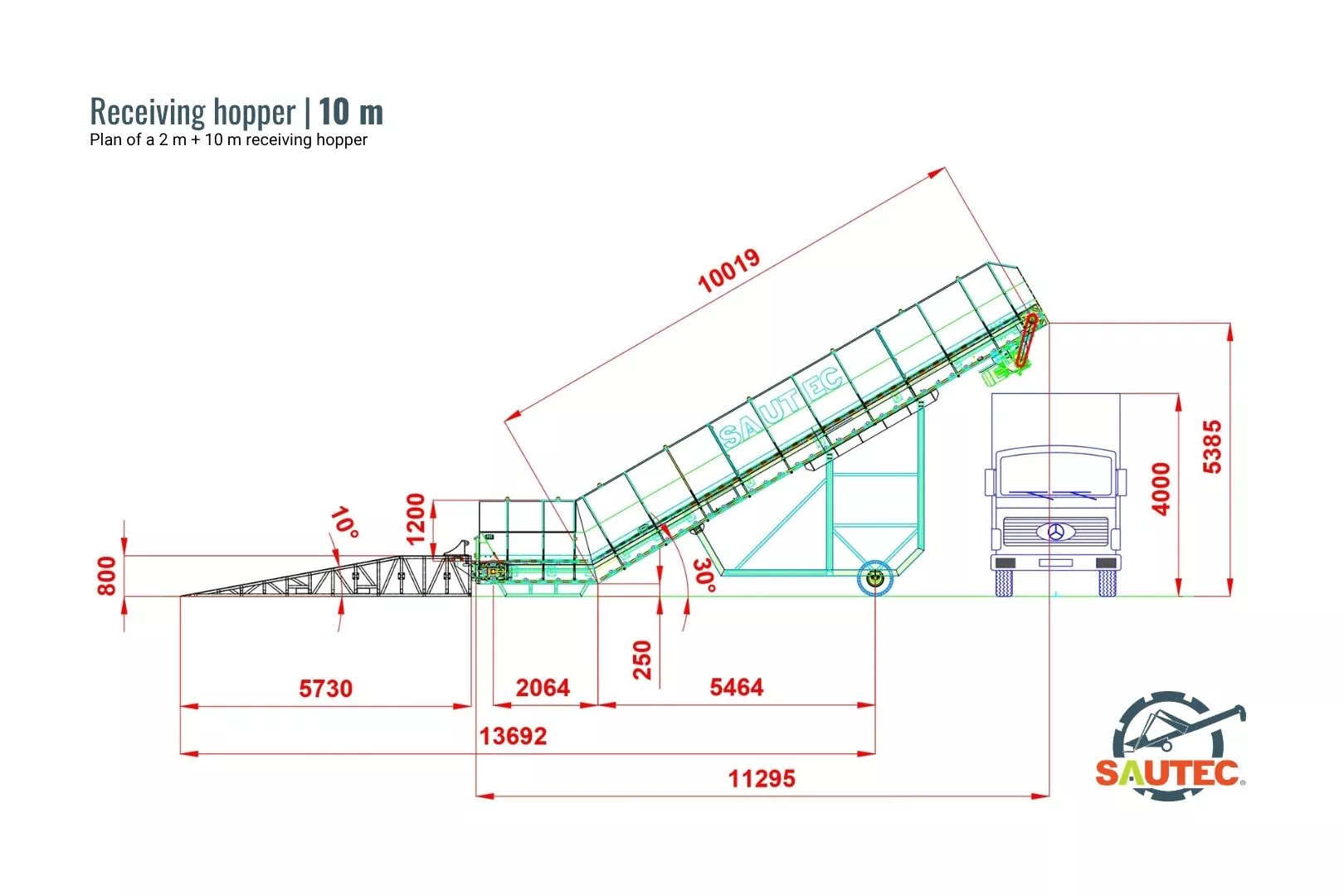
The side walls are high enough to effectively contain the flow of maize cobs during unloading. The length of the receiving hopper (2 m + 10 m, i.e. 12 m) has been designed to optimise the process: the first 2 metres are dedicated to receiving the cobs, whilst the following 10 metres ensure transfer and elevation thanks to a U21 PVC belt with a working width of 2 m, fitted with metal cleats.
Caractéristiques techniques:
- Receiving hopper 2 m + 10 m
- Receiving width: 3.5 m
- Receiving length: 2 m + 10 m
- Width of the moving floor: 2 m
- U21 PVC belt
- 9.2 kW gear motor with the reduction system and sprocket and chain drive
- Complete electrical cabinet with Schneider components
- Emergency stop on the electrical cabinet and remote emergency stops
- Rear and side sealing devices
Options selected by the customer:
- Frequency inverter
- Chassis with pneumatic wheels
- Loading ramp
- Rear side door with step
Results: reduced logistics costs, improved efficiency and greater competitiveness.
The new logistics system, with the help of receiving hoppers and the truck unloader, has delivered immediate and tangible results:
Cost reduction.
- A 25% reduction in transport costs per tonne compared with the previous system.
- A reduction in the fleet of skips, from 300 to 60 units, resulting in savings of approximately €240,000 on hire costs.
Operational gains.
- Greater flexibility in managing flows and organising harvests.
- Elimination of the risk of harvests being stopped due to a lack of available skips.
- A reduction in skip handling and associated risks.
- Simplified logistics that are clearer for all teams.$
Strategic impact.
Beyond the operational benefits, these logistical improvements strengthen Bayer’s overall competitiveness in a context of fierce regional competition among seed companies. Optimising costs and technical efficiency helps to improve the competitiveness of the production area and retain annual contracts with the region’s seed growers.
” Sautec has successfully adapted its solutions to improve our logistics. Their equipment is simple, mobile and easy to set up, which has enabled us to become operational quickly. This logistics model is now proving to be efficient, flexible and replicable, and is likely to inspire other seed companies.”
Théo Lafond, Field operation lead commercial seeds | Bayer